


Brownstown Township and the Unique Shape of Home
Story by Ken Welsch
Long before there was Downriver — even before there was Michigan — there was Brownstown Township. Back in the simpler days of the 1820s, township boundaries were much simpler, too.
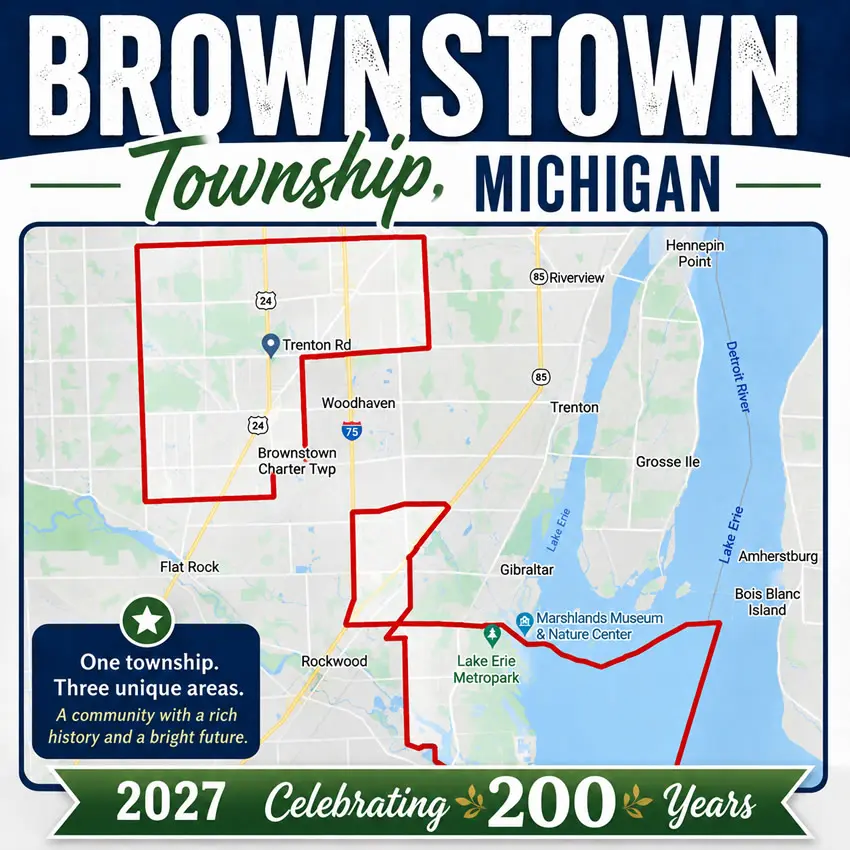
After 199 years, pieces of the original Brownstown still remain, but they are scattered across western and southern Downriver as three separate sections of land that, at times, do not even share a border. Even lifelong Downriver residents can get confused.
Residents often refer to these sections as the north end, the south end, and the mid-section. Each area offers its own unique charm and together they have earned Brownstown Township the unofficial title as one of the most uniquely shaped municipalities in Michigan.
The north end is the largest section and includes the busy I-75 and Telegraph Road corridors. The mid-section is the smallest and is wedged between I-75 and Fort Street south of Trenton. The south end is known for its rustic beauty, stretching along the Huron River to the shores of Lake Erie.
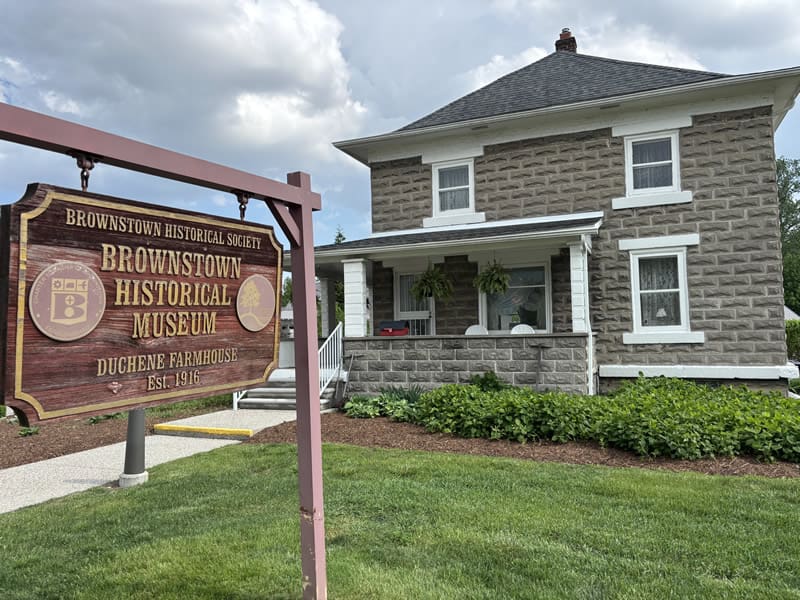
“It’s a fun story, but there can be some real friction because of it,” said Mike Sollars, president of the Brownstown Historical Society. “I think one of the biggest things is not having our own dedicated post office.”
Welcome to Brown’s Town
The story begins with Adam Brown. According to local lore, Brown was kidnapped from the South in the mid-1700s, brought to Michigan as a child, and raised among the Wyandot Indians. He later married a Native American woman and became an important tribal elder.
Brown was so influential that the settlement along the creek near present-day Gibraltar Road became known as “Brown’s Town.” Over time, the apostrophe disappeared, leaving the name Brownstown.
Brown eventually moved to Amherstburg, Ontario, after siding with the British during the War of 1812. He died there in 1823, but his name remained attached to the growing settlement across the river.
Officially recognized in 1827, Brownstown Township originally covered a massive portion of the Downriver region. Its borders stretched north to present-day Pennsylvania Road, west to Inkster Road, east to roughly Fort Street, and south to the Huron River. Brownstown was one of the original three townships that made up what we now call Downriver — and the only township that still remains today.
The 1960s: Days of Change
Aside from some land transfers in the 1840s, Brownstown remained largely intact for more than a century. That changed dramatically during the 1960s.
What began as a 43-square-mile township was nearly cut in half as communities separated and incorporated into independent cities. Gibraltar became a city in 1961, followed by Rockwood in 1964 and Woodhaven and Flat Rock in 1965.
Within just five years, Brownstown Township had been reduced to 22 square miles divided into three distinct sections.
Today, the township spans six ZIP codes and has no high school carrying the Brownstown name. Most students attend Woodhaven schools, while others attend Gibraltar or Taylor schools.
“You could have someone with a Brownstown mailing address, a Trenton ZIP code, and their kids go to Carlson,” Sollars joked.
A Bicentennial for All
Despite its unusual layout, Brownstown Township is preparing to celebrate its 200th birthday in 2027. Township leaders are planning bicentennial events throughout all three sections of the township, with the headline celebration scheduled for May 21–23, 2027.
“We want to make sure the celebration is all-inclusive,” Sollars said. “I think people in the south end sometimes feel forgotten about, but we’ll have something happening in all three sections.”
As part of the celebration, the township is also accepting entries for a bicentennial logo design contest, with submissions due by June 1, 2026.
“This is a unique opportunity for community members to leave a lasting mark on Brownstown’s history,” Sollars said. “We’re looking for a design that captures our rich heritage, strong community spirit, and vision for the future.” The link to the contest with the rules and complete information is www.brownstownhistory.org/200 .
That future includes plans for a downtown-style development near Telegraph and Dix-Toledo roads, helping continue Brownstown’s reputation as one of the fastest-growing communities in Downriver.
A Three-Part Symphony
Today, more than 33,000 people call Brownstown Township home. Some residents live near Detroit Metro Airport, while others can launch a canoe from their backyard into the Huron River.
Brownstown Township may look divided on a map, but together its three sections create something uniquely Downriver — a blend of thriving business corridors, growing neighborhoods, natural beauty, and strong community spirit.
After all, long before there was Downriver, there was Brownstown Township.